
Google Ads automation is only as good as its audit trail
The minimum observability layer an optimization tool needs: run health, change history, anomaly alerts and decision-level explanations.
Written by Touch Stone Editorial Team
Reviewed by Touch Stone Ads Technology Limited
A green job status proves very little
A script can complete without errors and still select the wrong campaigns, use an immature conversion window or make an unreasonable recommendation. Technical monitoring answers whether the code ran. Operational monitoring answers whether it touched the right entities and stayed inside policy.
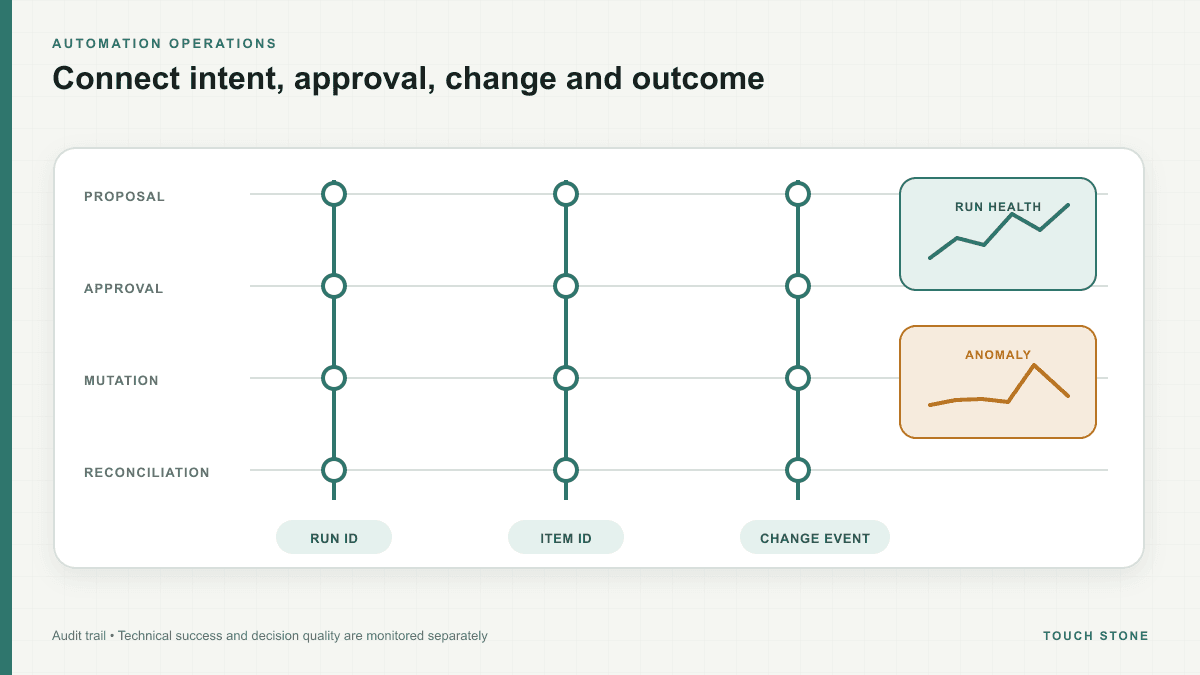
Capture both layers. Record start and finish time, account, version, row count and failures, then add the decision inputs, policy checks, proposed values, approval and mutation result. Without that chain, a team can see that spend changed but cannot explain why.
Build one trace across multiple systems
Give the run, proposal and each change item stable identifiers. Include them in application logs and the external audit ledger. Google Ads change-event data can then help reconcile field-level before-and-after values and identify the user or client type associated with a change.
Change-event reporting has timing and query constraints, so it should be treated as reconciliation evidence rather than the only source of state. The optimization platform still needs its own durable record of intent, review and execution.
- Run health: duration, version, account and failure class.
- Decision evidence: query window, inputs, thresholds and exclusions.
- Governance: proposer, reviewer, approval time and protected fields.
- Result: API response, live value, reconciliation status and rollback state.
Alert on business anomalies, not every fluctuation
Google's account anomaly detector example compares recent performance with historical behavior for the same weekday. That pattern is more useful than a fixed daily threshold when traffic naturally varies across the week.
Alerts still need a freshness allowance. The example notes that account statistics can be delayed, so an early comparison can produce a false alarm. State the data cut-off in the alert and suppress repeated notifications for the same unresolved event.
Make the review screen the fastest debugging tool
Operators should not have to search raw logs to answer basic questions. A change record should show the entity, before-and-after value, reason, policy checks and links to the relevant account view. Group failures by cause instead of displaying a wall of repeated messages.
This is more than compliance. Clear explanations shorten incident response and reveal which rules routinely produce low-value proposals. Observability turns automation from an opaque scheduled task into an operational system that can be improved.