
Budget automation needs guardrails, not just a pacing formula
A practical control system for budgets that accounts for time zones, conversion lag, minimum data and the cost of a wrong decision.
Written by Touch Stone Editorial Team
Reviewed by Touch Stone Ads Technology Limited
Pacing is a control problem, not a single equation
A familiar pacing calculation compares spend so far with the share of the period that has elapsed. It is useful, but it does not know whether demand is concentrated on certain weekdays, whether conversions arrive late or whether a campaign is intentionally front-loaded. A formula can therefore be mathematically correct and commercially wrong.
Start by defining the budget period, account time zone and data freshness. A midnight boundary in the application server is not necessarily midnight in the Google Ads account. Store the period and time zone with every recommendation so the same calculation can be reproduced during review.
Put hard limits outside the optimizer
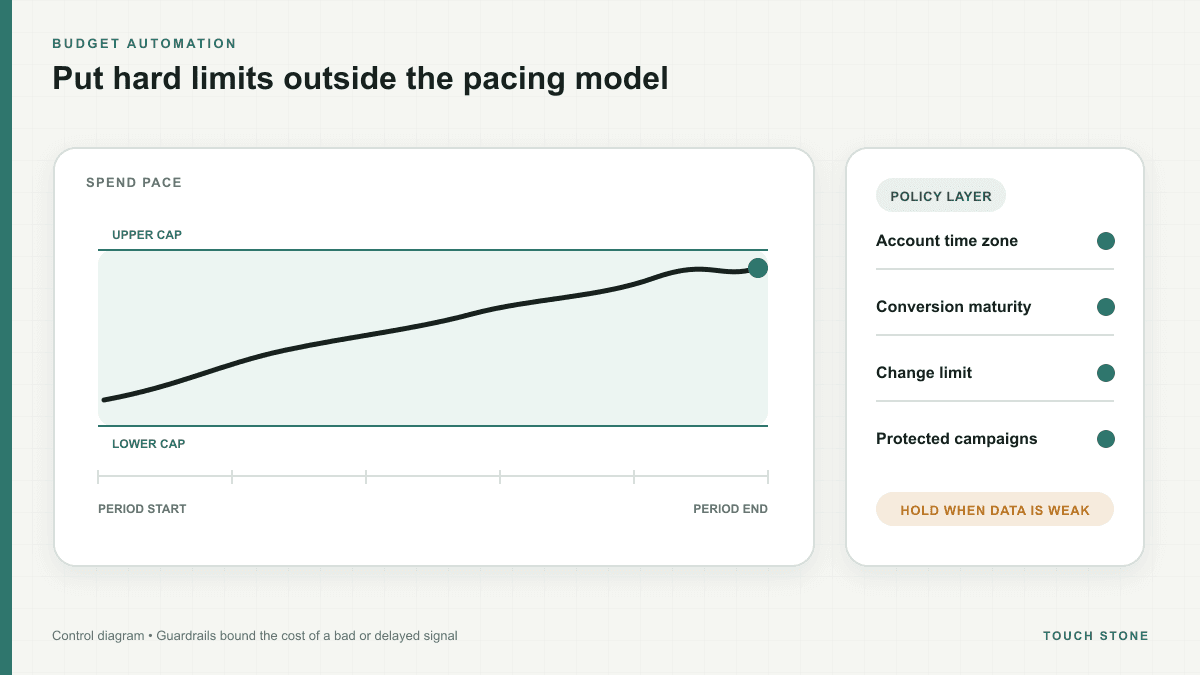
An optimizer should never be the only thing deciding how far it may move a budget. Independent policy controls need to limit the absolute value, percentage change, cumulative daily movement and number of campaigns affected. These controls should run again immediately before execution.
The goal is to bound the cost of a bad signal. If a conversion import is delayed or a query returns incomplete data, a strict movement cap turns a potential account-wide failure into a small, reviewable deviation.
- Set a minimum and maximum campaign budget.
- Limit each change and the total movement within a rolling period.
- Protect brand, launch and contractually committed campaigns.
- Require approval when money moves between business units or markets.
Conversion lag changes the meaning of today's performance
Google Ads reporting is not instantaneous, and conversions can be recorded after the click. A rule that repeatedly cuts bids or budgets because recent conversion data looks weak can create a negative spiral: spend falls, the sample gets smaller and the next decision becomes even less reliable.
Use a decision window that reflects the business conversion cycle, and exclude the most immature observations when appropriate. Pair performance metrics with evidence thresholds such as clicks, cost or elapsed time. When the evidence is insufficient, return no action rather than inventing certainty.
Treat exceptions as first-class workflow states
A robust budget system produces more than increase or decrease. It can hold, request review, mark data as delayed, or explain that a campaign is protected. Those outcomes make automation more trustworthy because silence is no longer confused with success.
Monitor the rules frequently and review their history. A good weekly operating ritual compares proposed changes, executed changes and actual outcomes. That is how teams find a wrong assumption in the guardrails before it becomes a recurring cost.