
Test the optimization policy before you automate the rollout
How to use control and treatment thinking to separate real incremental value from seasonality, attribution noise and optimistic backtests.
Written by Touch Stone Editorial Team
Reviewed by Touch Stone Ads Technology Limited
Historical fit is not incremental proof
A backtest can show that a rule would have flagged expensive keywords or reallocated budget toward past winners. It cannot observe how the auction, traffic mix and other campaigns would have changed after those interventions. Selecting strong historical patterns is not the same as causing better future performance.
Use the backtest to find implementation errors and estimate operational volume. Use an experiment or bounded pilot to evaluate whether the policy adds value under live conditions.
Write the decision rule before the result exists
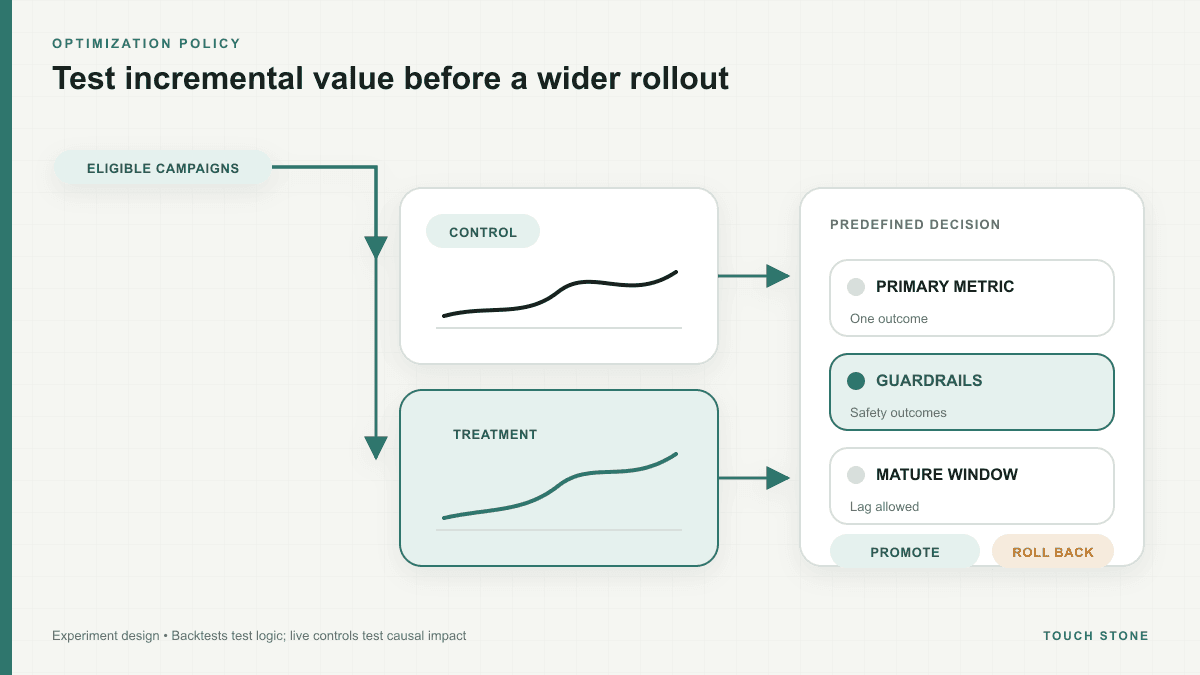
Google Ads experiments use control and treatment arms with a traffic split so metrics can be compared. Before launch, define the primary metric, secondary diagnostics, safety guardrails, minimum duration and how conversion lag will be handled.
Avoid changing several policies at once. If the treatment changes bidding, keywords and creative simultaneously, the outcome may be useful operationally but it will not explain which policy worked. One clearly defined change produces more reusable learning.
- State the hypothesis and eligible campaign population.
- Choose one primary outcome and a small set of guardrails.
- Set the traffic split, duration and maturity window in advance.
- Define conditions for promote, continue, stop and rollback.
Protect the test from operational contamination
Manual edits, overlapping rules and other optimization tools can erase the distinction between control and treatment. Label the experiment population, freeze conflicting automations and record all material changes during the test.
Check whether one arm encounters inventory, tracking or landing-page incidents that the other does not. A clean numerical comparison can still be misleading when the operating conditions diverge.
Promote gradually and keep the control logic
A positive result does not require an immediate account-wide rollout. Promote the policy to a broader but still bounded set, keep the same audit fields and watch for segments that were underrepresented in the experiment.
Preserve the experiment definition, code version and outcome after promotion. When performance later changes, the team can distinguish policy drift from market change and can recreate a sensible rollback baseline.