
Keyword automation without the blind pause button
A better decision framework for low-performing keywords that uses evidence thresholds, intent and reversible review states.
Written by Touch Stone Editorial Team
Reviewed by Touch Stone Ads Technology Limited
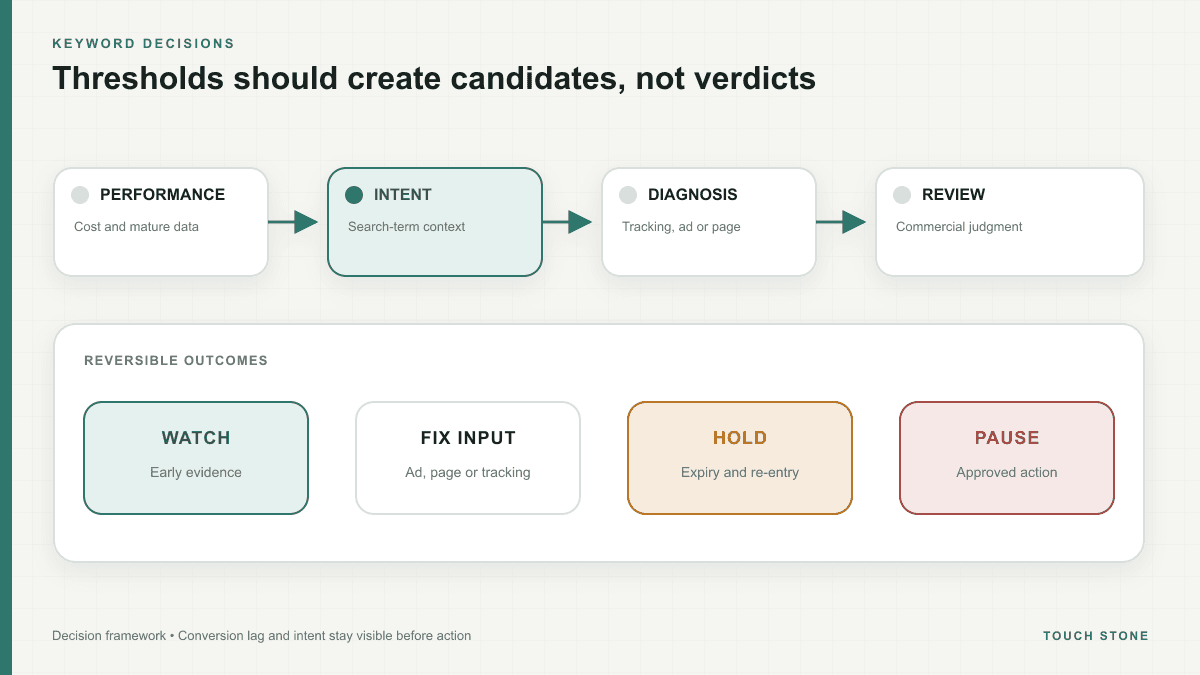
The easy rule ignores why a keyword underperformed
A script that pauses any keyword above a cost threshold with no conversions looks disciplined, but the observation can have several causes: delayed conversions, a broken landing page, a mismatched query, a tracking outage or a genuinely weak keyword. Only one of those is solved by pausing the keyword.
Use thresholds to generate candidates. Attach the search intent, match type, recent search terms, data window and conversion maturity to the proposal. The operator can then choose the intervention that fits the cause.
Require enough evidence for the cost of the decision
The minimum sample should not be a universal click count. A high-value, low-volume B2B term and a high-volume consumer term have different economics. Define evidence using cost, elapsed time, conversion cycle and the acceptable downside of waiting.
Recent observations should be discounted or held when conversions typically arrive later. If tracking health is unknown, suspend the optimization run. An automation should never turn a measurement incident into a wave of keyword pauses.
- Check tracking and data freshness before performance rules.
- Use a full, reproducible date window in the account time zone.
- Review search-term intent and landing-page alignment.
- Compare the candidate with its campaign and ad-group context.
Match type changes the diagnosis
A broad-match keyword can cover a wider range of queries than its text suggests, while an exact or phrase keyword carries different control implications. The decision record should therefore include both the keyword and the search-term evidence that drove the flag.
If the problem is a narrow set of irrelevant queries, a reviewed negative may be more appropriate than pausing the source keyword. If the landing page or ad message is weak, fixing the destination or creative may preserve useful intent.
Use hold, watch and re-entry states
A binary active-or-paused system hides uncertainty. Add watch for early evidence, hold for a reversible intervention and review required for strategically important terms. Store an expiry date and re-entry condition so temporary decisions do not become permanent account debris.
Measure the decision after execution. If a hold changes traffic mix but not efficiency, the system should surface that result. Optimization quality comes from learning which actions worked, not from maximizing the number of automated changes.