
Negative keyword automation needs a conflict check and a review queue
How to reduce irrelevant traffic without blocking valuable demand through overly broad or context-free exclusions.
Written by Touch Stone Editorial Team
Reviewed by Touch Stone Ads Technology Limited
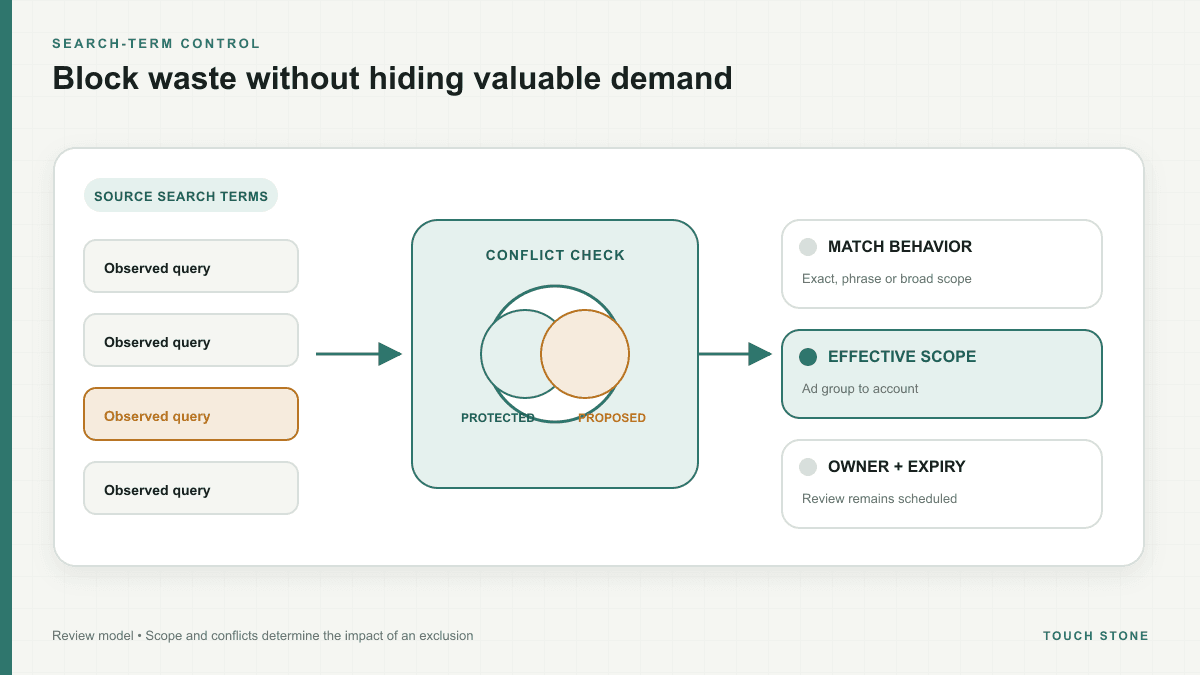
An irrelevant query is evidence, not the final negative
Search-term mining tools often extract a word from an irrelevant query and propose it as a negative. The extracted token may also appear inside high-value queries, product names or future categories. Applying it broadly can remove more demand than the original waste justified.
Keep the full source query, campaign context and reason with the proposal. Recommend the narrowest match type and scope that addresses the observed problem. A reviewer should see examples of traffic that would be blocked, not just the proposed word.
Negative matching has different semantics
Google notes that negative keywords behave differently from positive keywords and do not match close variants in the same way. That distinction is easy to miss when a tool reuses positive-keyword logic for exclusions.
Build explicit tests for phrase order, additional words, singular and plural forms, misspellings and multi-word negatives. The interface should explain the expected blocking behavior in plain language before approval.
Run conflict detection across every applicable scope
A negative can live at several levels, including ad group, campaign, list and account. Before applying a proposal, compare it with enabled positive keywords, brand terms, protected products and existing negatives at every scope that can affect the campaign.
Severity should reflect reach. An exact negative in one ad group is not equivalent to a broad account-level exclusion. Route broad, phrase and shared-scope changes through stricter approval, and keep account-level negatives under explicit administrative control.
- Show the original search term and recent performance.
- Simulate representative queries that would and would not be blocked.
- Flag conflicts with protected terms and enabled keywords.
- Display the effective scope and all campaigns inheriting the change.
Give exclusions an owner and a review date
Negative lists accumulate quietly while product lines, language and customer intent change. Add an owner, reason and review date to every automated exclusion. Temporary negatives for inventory or promotions should have an expiry condition.
The goal is not the largest negative list. It is a controlled reduction in irrelevant traffic without hiding valuable demand. Report both prevented waste and conflict reversals so the team can judge whether the automation is becoming more precise.