
Google Ads scripts, automated rules or API: choose the smallest safe tool
A decision guide for matching automation complexity with the right execution surface, governance model and operating cost.
Written by Touch Stone Editorial Team
Reviewed by Touch Stone Ads Technology Limited
Start with the decision, not the technology
Teams often choose a tool because it is familiar: a rule for speed, a script for flexibility or an API because the product roadmap sounds ambitious. The better starting point is the decision frequency, number of accounts, evidence needed, acceptable failure size and level of human review.
A daily pause rule for one account and a cross-account optimization platform are different operating systems. They should not share the same architecture merely because both can change a campaign.
Automated rules suit narrow, transparent conditions
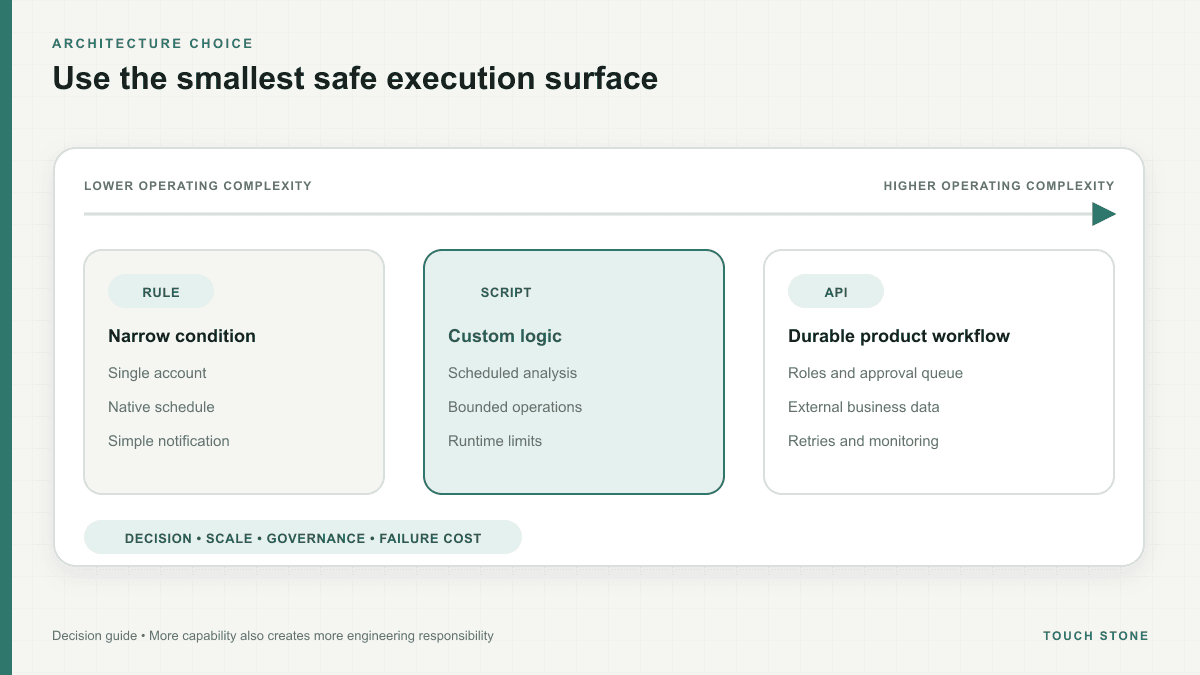
Rules work well when the condition and action are simple, the scope is easy to inspect and Google Ads' scheduling and notifications are sufficient. They are less suitable when a decision needs joins, external business data, multi-step review or precise item-level retry handling.
Even a simple rule needs minimum and maximum limits, enough data and regular review. The convenience of the interface does not remove conversion lag or the risk of repeated corrective changes.
Scripts add logic but inherit a runtime envelope
Scripts can query with GAQL, use labels, batch work and operate across manager-account structures. They are a strong fit for analysis, monitoring and bounded account maintenance. Their execution, row, selector, logging and upload limits should be treated as architectural constraints rather than surprises.
When a workflow needs a durable approval queue, user roles, external databases, extensive reconciliation or service-level monitoring, the script should often become a read or proposal component instead of the whole product.
- Choose a rule for a small, explainable condition-action pair.
- Choose a script for scheduled analysis and bounded account operations.
- Choose the API for durable workflows, product interfaces and larger-scale coordination.
- Keep review and policy controls independent of the execution surface.
An API platform creates freedom and responsibility
The Google Ads API supports richer services, reporting and recommendation workflows, but the team must own credentials, quotas, version upgrades, state, retries, monitoring and user-facing explanations. The API removes some platform constraints and exposes more engineering obligations.
Google Ads recommendations can be retrieved, applied or dismissed, and some types support automatic application. Treat them as inputs to an acceptance policy rather than universal truth. Recommendation types and availability can change, so product logic must tolerate additions, removals and incomplete coverage.
The right architecture can change over time
Begin with the smallest safe tool and a clean audit model. If the volume, evidence sources or governance requirements grow, the stable proposal schema and operating history make migration easier.
Complexity is justified when it buys clearer decisions, safer execution or lower operating cost. If a larger system only produces more changes without better review and measurement, it is not a more mature automation.